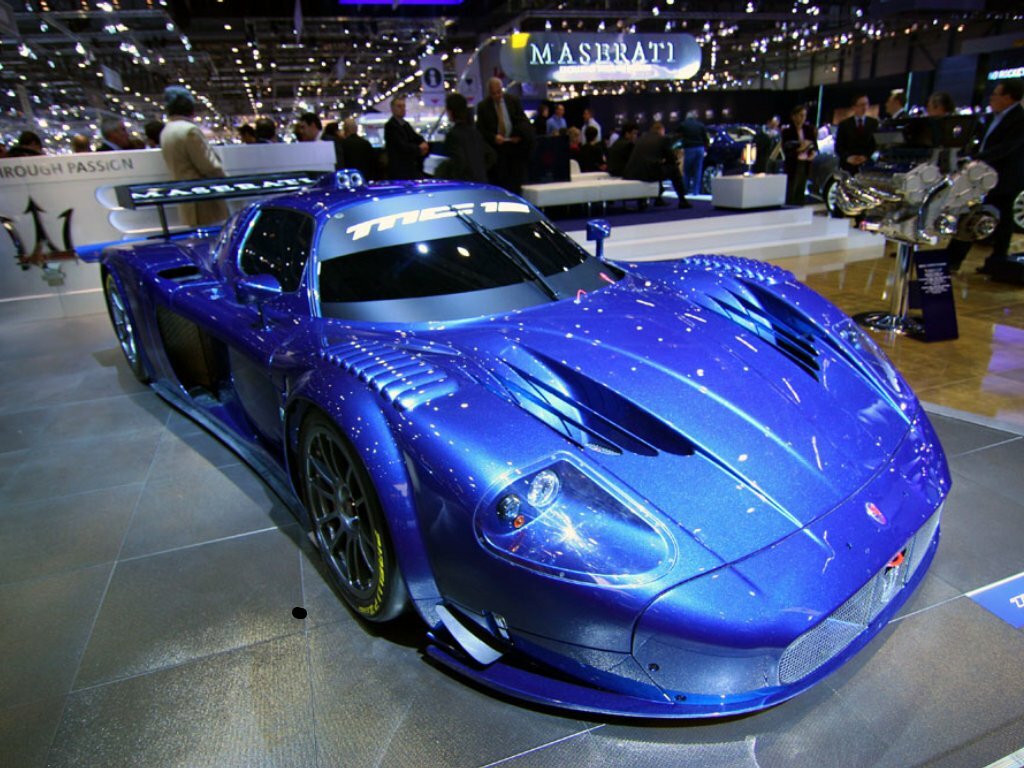
The MC12 is Maserati’s new road-based Grand Tourer model, from which the company has also developed a GT racetrack version. Thirty-seven years after Maserati’s last international championship victory in 1967, the marque is making its return to the track. The
Ferrari-
Maserati group’s depth of experience and excellence has gone into the design of this new model – its body shape was tested and developed in a wind tunnel. The European version of the MC12 went on sale in the summer of 2004.
The MC12 can top 205 mph at full throttle, accelerating from 0-62 mph in 3.8 seconds. On the road, its handling is smooth and controlled, yet this does not detract from the genuine power of this sporty model. On the track, the MC12 has already demonstrated its pedigree in its successful debut in the Daytona 24 Hour Race. Maserati’s Racing Division is currently undertaking steps to help the new car satisfy the criteria for entry into all the principal international racing championships.
The road version will only be available in blue and white trim – a throwback to an old
Maserati tradition. These were the colours sported by the famous
Maserati Tipo 60-61 Birdcages raced in the early 1960s by the team led by Stirling Moss.
Light and rigid
The MC12 is a coupe/spider, two-seater sports car with an extended wheel base (2800 mm), boasting a standard racing/sports setup and detachable hardtop. Its powerhouse is an outstanding 630 bhp, 6.0 litre mid-mounted V12 engine, providing a 41% front and 59% rear weight ratio. Its structural durability is improved with specialised composites and alloys, which help to keep the car’s weight to a minimum. The MC12’s bodywork is constructed entirely from carbon fibre, and the chassis from a combination of carbon fibre and Nomex honeycomb.
The MC12’s 12-cylinder 65° V engine has a displacement of 5998 cc, and at 7,500 rpm has an impressive output of 630 bhp. It offers a peak torque of 481 l/ft at 5,500 rpm, remaining agile, dextrous and pleasantly driveable across the engine’s full range of capabilities. It boasts an aluminium crankcase, con rods made from titanium and superb aerodynamic efficiency via its four-valve cylinder heads. Immaculate timing control is provided by four gear-driven, overhead camshafts for each cylinder.
Interior
The MC12’s detachable hardtop allows for the conversion of the car from spider to coupe and vice versa. Refinement and sporting pedigree epitomise the cabin itself – uncomplicated and low-key, yet showcasing the attention to detail that has come to be expected from
Maserati. The high-tech carbon finish, attractive leather trim and high-grip fabrics create an impressive harmony in the cabin’s interior.
Only 30 MC12’s were built in 2004, of which 25 were for road use. Another series of 25 road-based MC12’s were built the following year, in 2005.
The MC 12 dominated the 2005 24 Hours of Spa,
taking the 1st and 2nd place, the first time a
Maserati has won outright a 24 hours race.
Maserati is also writing a new chapter in the
history books, with a strong lead the FIA GT
Constructor Championship, which would be the
first ever for the house of the Trident.
Engine / Performance
• 6L naturally aspirated V12, mid rear-mounted
• Maximum power: > 700 bhp
• Maximum torque: > 487 lb-ft
• 0.60 mph: 2.7 sec
• Top Speed: > 205 mph
Chassis / Body
• Carbon and Nomex honeycomb monocoque chasis
• carbon fiber bodywork
Transmission / Gearbox
• Transaxle architecture (longitudinal rear-mounted
gearbox rigdly connected to the engine)
• Maserati Cambicorsa 6 speed electro-hydraulic
transmission and paddles mounted behind the
steering wheel


© 2006 Martin Hemmings and Chris Ostberg (AudiWorld.com) for www.sport-cars.org
April 1, 2008, 11:01 am
The most viewed articles in current category: